Online vs. In-Person Higher Ed 2025: Learning Outcomes Analysis
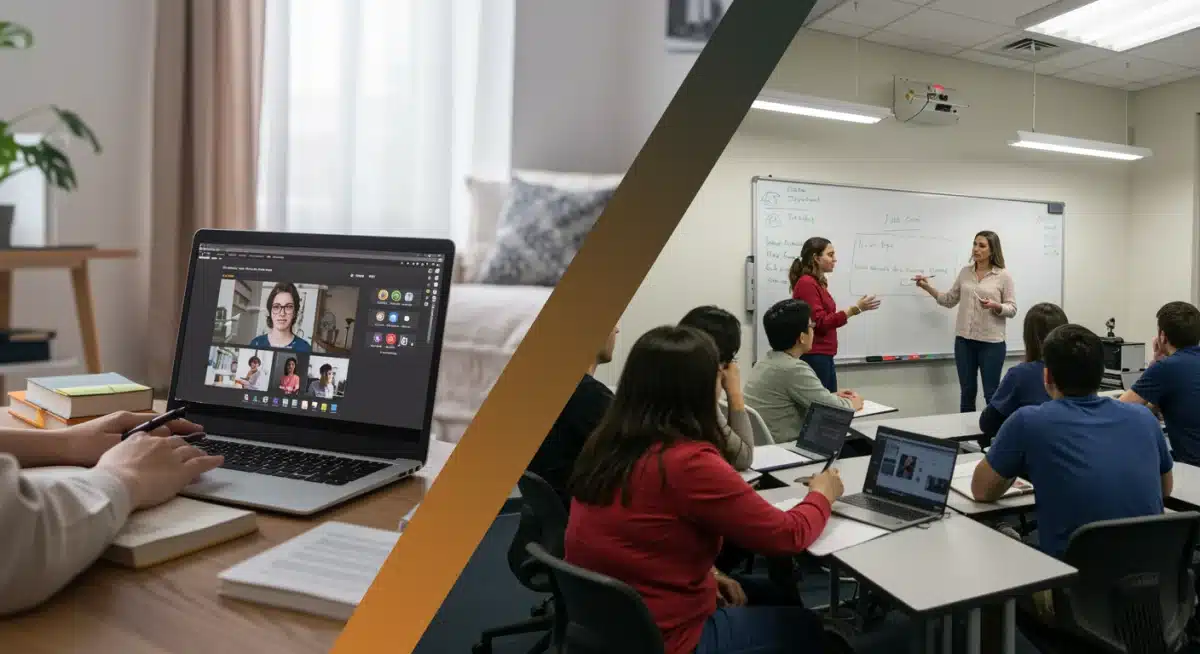
Comparing online vs. in-person higher education in 2025 reveals distinct advantages and challenges in learning outcomes, student engagement, and skill acquisition across various academic disciplines.
As we navigate the complexities of 2025, the debate surrounding online vs in-person education in higher learning continues to evolve. What truly sets these two modalities apart in terms of effectiveness and student experience? Let’s delve into a comprehensive analysis to uncover the nuances.
The evolving landscape of higher education in 2025
The year 2025 marks a crucial point in higher education, with institutions having largely adapted to the technological shifts initiated by recent global events. Both online and in-person models have undergone significant transformations, integrating advanced tools and methodologies to enhance learning. Understanding these developments is key to evaluating their respective merits and challenges.
The rapid advancements in educational technology have blurred the lines between traditional and virtual classrooms. Universities are now leveraging AI, virtual reality, and personalized learning platforms to deliver content, assess progress, and foster engagement, regardless of the delivery method. This era calls for a re-evaluation of what constitutes effective learning.
Technological integration in modern learning
Technology has become an indispensable component of both online and in-person education. From interactive whiteboards in physical classrooms to AI-powered tutors in virtual environments, these tools aim to create richer, more engaging learning experiences. This integration also facilitates data collection, allowing educators to tailor content and support to individual student needs.
- Personalized learning paths driven by AI algorithms.
- Virtual reality simulations for hands-on experience in various fields.
- Collaborative online platforms for group projects and discussions.
- Advanced analytics to track student progress and identify areas for improvement.
Ultimately, the landscape of higher education in 2025 is characterized by a dynamic interplay of innovation and adaptation. Institutions are striving to optimize both online and in-person offerings, recognizing that each serves distinct student populations and learning preferences. The focus remains on maximizing learning outcomes in an increasingly complex academic environment.
Academic performance and learning outcomes: a deep dive
When assessing academic performance, the comparison between online and in-person learning outcomes reveals a complex picture. Research in 2025 suggests that the effectiveness of each modality often depends on the discipline, the student’s learning style, and the quality of instructional design. No single approach universally outperforms the other across all metrics.
For instance, disciplines requiring extensive lab work or hands-on practice, such as engineering or medicine, traditionally benefit from in-person instruction. However, advancements in virtual labs and simulation technologies are progressively closing this gap. Conversely, fields relying heavily on critical thinking, research, and written communication often thrive in well-structured online environments.
Factors influencing academic success
Several factors contribute to academic success in both online and in-person settings. These include student motivation, instructor engagement, access to resources, and the overall design of the curriculum. In online courses, self-discipline and time management are paramount, while in-person settings often benefit from immediate peer interaction and structured routines.
- Student self-regulation and intrinsic motivation.
- Quality of instructor-student interaction and feedback.
- Availability of academic support services (tutoring, counseling).
- Curriculum design that aligns with learning objectives.
The key takeaway is that effective learning outcomes are less about the mode of delivery and more about the pedagogical approaches employed within that mode. High-quality instruction, regardless of whether it’s online or in-person, remains the most critical determinant of student achievement and knowledge acquisition.
Student engagement and interaction: fostering connections
Student engagement and interaction are vital components of a fulfilling higher education experience, directly impacting learning and retention. In 2025, both online and in-person models have developed sophisticated strategies to foster these connections, though their approaches differ significantly.
In-person environments inherently offer spontaneous interactions—hallway conversations, group projects in physical spaces, and direct classroom discussions. These informal exchanges contribute significantly to a sense of community and belonging. Online platforms, however, have evolved to include advanced discussion forums, virtual breakout rooms, and collaborative digital tools that facilitate structured and asynchronous interactions.
Building community in virtual spaces
Creating a strong sense of community in online learning requires intentional design and active facilitation. Instructors utilize various techniques, from icebreaker activities to peer review assignments, to encourage students to connect with each other. Social learning platforms and dedicated communication channels also play a crucial role in replicating some aspects of the in-person collegiate experience.
- Synchronous virtual meetings and live Q&A sessions.
- Dedicated online discussion boards and peer collaboration tools.
- Virtual social events and student clubs.
- Personalized outreach from instructors and support staff.
While in-person learning often provides a more immediate and organic social experience, online education is steadily improving its capacity to build meaningful connections. The effectiveness of engagement ultimately relies on both the design of the learning environment and the proactive participation of students and instructors.
Flexibility and accessibility: widening horizons
The advantages of flexibility and accessibility are undeniable strengths of online higher education, significantly widening access to learning opportunities for diverse populations in 2025. This stands in contrast to the more rigid structure often associated with traditional in-person models, though even these are incorporating greater adaptability.
Online programs cater to students with work commitments, family responsibilities, geographic limitations, or disabilities, who might otherwise find it challenging to pursue higher education. The ability to learn at one’s own pace and on one’s own schedule is a game-changer for many. In-person institutions are also responding by offering hybrid courses and more flexible scheduling options, acknowledging the demand for adaptable learning pathways.
Overcoming barriers to education
Online education has proven particularly effective in breaking down geographical and socio-economic barriers. Students from rural areas or those unable to relocate for college can access top-tier programs. Furthermore, the often lower operational costs of online delivery can translate into more affordable tuition fees, making higher education more attainable for a broader demographic.
- Access to specialized programs not available locally.
- Reduced commuting and relocation expenses.
- Accommodation for diverse learning speeds and styles.
- Opportunities for lifelong learners to upskill or reskill.
The emphasis on flexibility and accessibility in both modalities reflects a broader societal need for inclusive education. While online learning leads in this aspect, in-person institutions are increasingly recognizing the importance of offering adaptable options to remain competitive and relevant in the evolving educational landscape.
Skill development: beyond academic knowledge
Beyond the acquisition of academic knowledge, higher education in 2025 is increasingly focused on developing critical soft skills essential for the modern workforce. The discussion around online vs in-person education extends to how effectively each modality cultivates these crucial competencies.
In-person learning environments traditionally excel at fostering interpersonal communication, teamwork, and leadership through direct group activities, presentations, and extracurricular involvement. The immediate feedback and non-verbal cues present in face-to-face interactions are invaluable for refining these skills. However, online learning has also proven to be highly effective in developing other vital competencies.
Cultivating 21st-century skills
Online education inherently promotes skills such as self-discipline, time management, digital literacy, and independent problem-solving. Students in virtual settings often become adept at asynchronous communication, virtual collaboration, and navigating complex digital platforms—skills that are highly sought after in today’s remote-friendly work environments. Both modalities, therefore, contribute to a holistic skill set.
- Enhanced digital literacy and technological proficiency.
- Improved self-management and organizational skills.
- Development of written communication and virtual collaboration.
- Adaptability to diverse learning and working environments.
Ultimately, the goal is to equip students with a robust set of skills that transcend disciplinary boundaries. Both online and in-person modalities contribute distinctively to this objective, highlighting the importance of choosing a learning environment that aligns with individual development goals and career aspirations.
The future outlook: hybrid models and personalized learning
Looking ahead, the future of higher education in 2025 and beyond is not about an either/or choice between online and in-person, but rather a convergence towards more sophisticated hybrid models and highly personalized learning experiences. This integrated approach seeks to leverage the strengths of both modalities while mitigating their weaknesses.
Hybrid learning, which combines elements of both online and face-to-face instruction, is gaining significant traction. This model offers students the flexibility of online learning with the benefits of in-person interaction, allowing for a more tailored educational journey. Universities are investing in infrastructure and pedagogical training to support these blended environments effectively, ensuring seamless transitions between virtual and physical spaces.
Innovations driving future education
Personalized learning, powered by AI and data analytics, is set to become even more pervasive. This involves tailoring curriculum content, pace, and teaching methods to each student’s individual needs, preferences, and learning styles. The integration of adaptive learning technologies will ensure that students receive targeted support and challenging content exactly when and where they need it.
- Adaptive learning platforms that adjust to student performance.
- Micro-credentials and modular learning pathways for flexible skill acquisition.
- Augmented reality (AR) and virtual reality (VR) for immersive learning.
- Emphasis on interdisciplinary studies and real-world project-based learning.
The future outlook for higher education is one of continuous innovation, with a strong focus on student-centric approaches. The aim is to create resilient, adaptable, and highly effective learning ecosystems that prepare individuals not just for careers, but for lifelong learning and societal contributions in an ever-changing world.
| Key Aspect | Description |
|---|---|
| Learning Outcomes | Vary by discipline and instructional quality; no universal winner. |
| Student Engagement | In-person offers spontaneous interaction; online uses structured digital tools. |
| Flexibility & Access | Online excels in providing accessibility; in-person adopting hybrid options. |
| Skill Development | Both foster unique soft skills; online enhances digital literacy, in-person communication. |
Frequently asked questions about higher education modalities
By 2025, the stigma associated with online degrees has largely diminished, especially from accredited institutions. Employers increasingly value the skills and knowledge gained, regardless of the delivery method, focusing more on the quality of the program and the institution’s reputation.
Both online and in-person modalities can effectively foster critical thinking. The key lies in the pedagogical design: challenging curricula, active learning strategies, and opportunities for debate and analysis are crucial, regardless of whether they occur in a virtual forum or a physical classroom.
Technology has profoundly enhanced online education by 2025, introducing interactive platforms, AI-powered personalization, and virtual reality simulations. These advancements have made online learning more engaging, accessible, and effective, bridging many gaps previously existing between online and in-person experiences.
Absolutely. In-person education remains highly relevant, offering unique benefits like immediate social interaction, spontaneous networking, and hands-on experiences that are difficult to fully replicate online. It provides a distinct collegiate experience that many students still seek and value deeply.
Key considerations include your learning style, self-discipline, career goals, financial situation, and personal circumstances. Evaluate which environment best supports your academic success, skill development, and overall well-being. A hybrid approach might also be a viable option for many.
Conclusion
The comparison between online and in-person higher education in 2025 reveals that both modalities offer distinct advantages and challenges. While online learning excels in flexibility and accessibility, fostering digital literacy and self-management, in-person instruction often provides richer social interaction and traditional skill development. The future points towards integrated hybrid models and personalized learning experiences, recognizing that the most effective education caters to individual needs and leverages the best of both worlds. Ultimately, informed choices about higher education will depend on a nuanced understanding of these evolving landscapes and how they align with personal and professional goals.