2026 EITC Eligibility: Claim Your Refund Up to $7,430

Anúncios
Understanding your eligibility for various tax credits can significantly impact your financial well-being, and one of the most impactful is the Earned Income Tax Credit (EITC). As we look ahead to the 2026 tax year, it’s crucial to be informed about the requirements and potential benefits of this credit. The 2026 EITC eligibility could mean a refund of up to $7,430 for qualifying individuals and families. This comprehensive guide will break down everything you need to know, from who qualifies to how to claim your rightful refund, ensuring you don’t leave any money on the table.
Anúncios
What is the Earned Income Tax Credit (EITC)?
The Earned Income Tax Credit, or EITC, is a refundable tax credit for low-to-moderate-income working individuals and families. It’s designed to provide financial relief and encourage work. Unlike some other tax credits, the EITC is refundable, meaning that even if you owe no tax, you can still receive a refund if the credit amount exceeds your tax liability. This makes it an incredibly valuable benefit for millions of Americans.
The EITC has been a cornerstone of federal tax policy since 1975, evolving over the years to better serve its intended purpose. Its primary goal is to offset the burden of Social Security taxes and to provide an incentive for low-wage workers to remain in the workforce. For the 2026 tax year, the maximum credit amount is projected to be around $7,430 for those with three or more qualifying children, though this amount can vary based on inflation adjustments and legislative changes. Even those without children may qualify for a smaller, but still significant, credit.
Understanding the nuances of the EITC is key to maximizing your tax refund. This credit is not automatically applied; you must specifically claim it when you file your tax return. Failing to do so means missing out on potentially thousands of dollars. Our focus here is on helping you navigate the complexities of 2026 EITC eligibility to ensure you receive every dollar you deserve.
Anúncios
Who Qualifies for the 2026 EITC? Key Eligibility Criteria
Determining your 2026 EITC eligibility involves several factors, including your income, filing status, and whether you have qualifying children. The IRS sets specific thresholds and rules that must be met. Let’s delve into the primary criteria:
1. Earned Income Requirements
To qualify for the EITC, you must have earned income. This includes wages, salaries, tips, and other taxable employee compensation, as well as net earnings from self-employment. Investment income must be below a certain threshold (which is adjusted annually for inflation – for 2026, this threshold will be announced closer to the tax year, but historically it’s been around $11,000 for 2024). If your investment income exceeds this limit, you will not qualify for the EITC.
- Wages and Salaries: Income reported on a W-2.
- Self-Employment Income: Net earnings from a business or farm. You generally need to pay self-employment tax.
- Union Strike Benefits: Taxable benefits received.
- Disability Retirement Benefits: If received before minimum retirement age and reported as wages.
It’s important to note that certain types of income do not count as earned income for EITC purposes, such as welfare benefits, unemployment compensation, Social Security benefits, and child support. Your earned income must also be below a certain limit, which varies depending on your filing status and the number of qualifying children you have. These limits are subject to annual adjustments.
2. Adjusted Gross Income (AGI) Limits
Your Adjusted Gross Income (AGI) is another critical factor. The IRS sets maximum AGI limits that you cannot exceed to qualify for the EITC. These limits are also dependent on your filing status and the number of qualifying children. For example, for the 2024 tax year, the maximum AGI for a married couple filing jointly with three or more children was around $63,698. While 2026 figures will be higher due to inflation, the principle remains the same: your AGI must fall within the specified range.
3. Filing Status
Your filing status plays a significant role in 2026 EITC eligibility. You generally cannot claim the EITC if your filing status is "Married Filing Separately." Eligible filing statuses typically include:
- Single
- Head of Household
- Qualifying Widow(er) with Dependent Child
- Married Filing Jointly
If you are married, you must generally file a joint return to claim the EITC. There are very limited exceptions to this rule, such as if you are legally separated or if you did not live with your spouse for the last six months of the tax year and you have a qualifying child living with you.
4. Social Security Number (SSN) Requirement
You, your spouse (if filing jointly), and any qualifying children listed on your return must each have a valid Social Security Number (SSN) issued by the Social Security Administration by the due date of your return (including extensions). An Individual Taxpayer Identification Number (ITIN) is not sufficient for EITC purposes.
5. U.S. Citizenship or Resident Alien Status
You must be a U.S. citizen or a resident alien all year. If you were a nonresident alien for any part of the tax year, you generally cannot claim the EITC unless you are married to a U.S. citizen or resident alien and elect to treat yourself as a resident alien for the entire tax year.
6. Not a Qualifying Child of Another Person
You cannot be a qualifying child of another person. If someone else can claim you as a qualifying child on their tax return, you cannot claim the EITC for yourself.
Qualifying Children: What You Need to Know
One of the most complex aspects of 2026 EITC eligibility often revolves around the definition of a "qualifying child." The rules are specific and must be met for each child you claim:
1. Relationship Test
The child must be your son, daughter, stepchild, foster child, brother, sister, half brother, half sister, stepbrother, stepsister, or a descendant of any of them (e.g., your grandchild, niece, or nephew).
2. Age Test
At the end of the tax year, the child must be:
- Under age 19, and younger than you (and your spouse, if filing jointly), OR
- Under age 24, a full-time student, and younger than you (and your spouse, if filing jointly), OR
- Any age and permanently and totally disabled.
3. Residency Test
The child must have lived with you in the United States for more than half of the tax year. Temporary absences due to special circumstances (e.g., illness, education, business, vacation, or military service) count as time lived at home.
4. Joint Return Test
The child cannot file a joint return for the year, unless they filed it only to claim a refund of withheld income tax or estimated tax paid.
5. Citizenship Test
The child must be a U.S. citizen or a resident alien.
It’s crucial to understand these rules thoroughly. Incorrectly claiming a qualifying child can lead to significant penalties and delays in receiving your refund. If you have questions, it’s always best to consult the IRS guidelines or a tax professional.

Calculating Your 2026 EITC: Factors and Estimates
The amount of EITC you can receive depends on several variables: your income, your filing status, and the number of qualifying children you have. While the exact figures for 2026 won’t be finalized until closer to the tax year, we can use current trends and historical data to provide estimates and explain the calculation process.
Maximum Credit Amounts (Estimated for 2026)
Based on inflation adjustments, the maximum EITC amounts for 2026 are expected to be roughly in these ranges:
- No qualifying children: Approximately $600-$700
- One qualifying child: Approximately $3,900-$4,100
- Two qualifying children: Approximately $6,400-$6,600
- Three or more qualifying children: Approximately $7,400-$7,600
These figures are illustrative and subject to change. The actual credit amount is phased in as your earned income increases, reaches a maximum, and then phases out as your income continues to rise. This means there’s an optimal income range to receive the highest credit.
The Phase-In and Phase-Out Process
The EITC calculation is not a simple linear process. It involves a "phase-in" and "phase-out" mechanism:
- Phase-In: As your earned income increases from zero, the EITC amount grows proportionally until it reaches its maximum. This is designed to reward work.
- Maximum Credit: Once your earned income hits a certain point, you receive the maximum EITC for your filing status and number of children.
- Phase-Out: After your income exceeds the maximum credit threshold, the EITC begins to gradually decrease until it reaches zero. This ensures the credit primarily benefits low-to-moderate-income individuals.
The specific income thresholds for these phases are adjusted annually by the IRS. Keeping track of your earned income and AGI throughout the year can help you estimate your potential EITC.
How to Claim Your 2026 EITC Refund
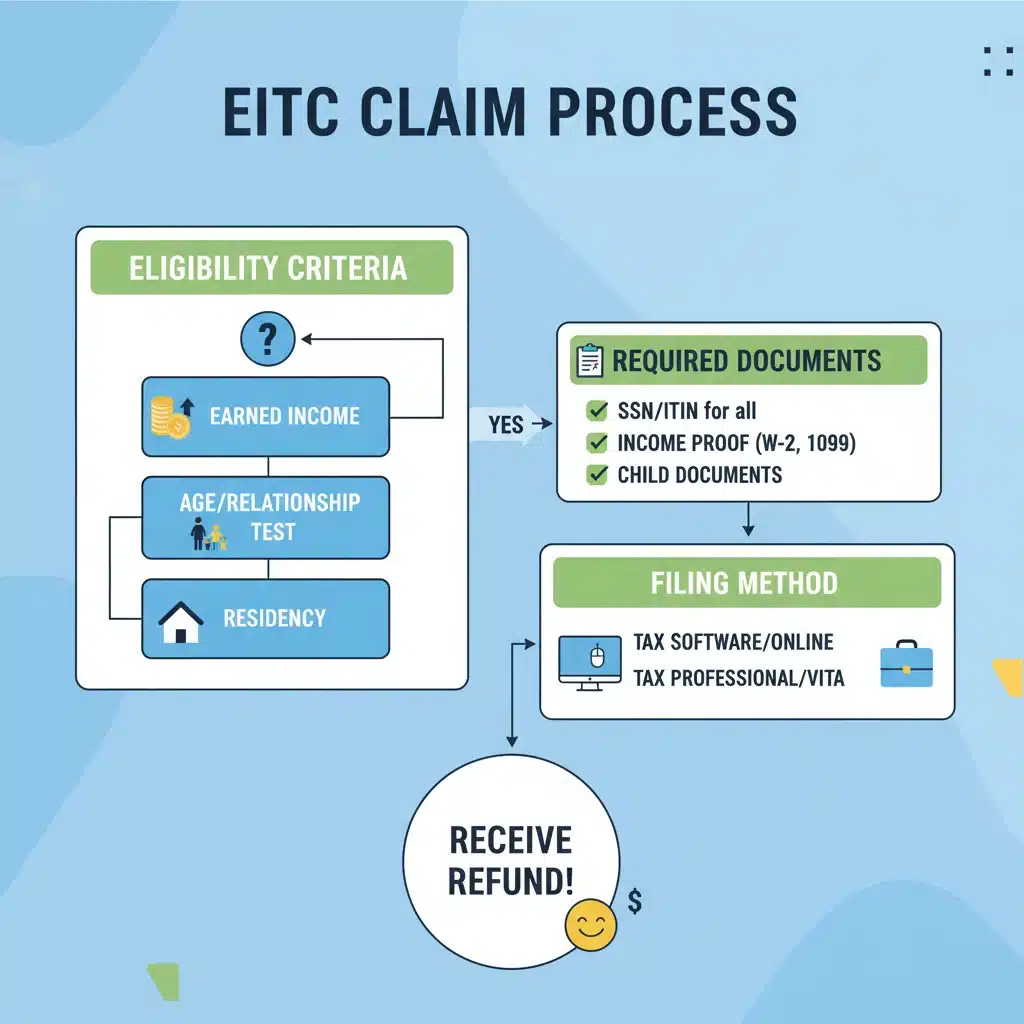
Claiming the EITC is not automatic; you must actively do so when you file your federal income tax return. Here’s a step-by-step guide:
1. Gather Your Documents
Before you begin, collect all necessary tax documents. This includes:
- Forms W-2 from all employers.
- Forms 1099-MISC or Schedule C if you are self-employed.
- Social Security numbers for yourself, your spouse, and all qualifying children.
- Records of any other income or deductions.
2. Choose Your Filing Method
You have several options for filing your tax return and claiming the EITC:
- Tax Software: Most tax preparation software (e.g., TurboTax, H&R Block) will guide you through the EITC questions and calculate the credit for you.
- IRS Free File: If your income is below a certain threshold (typically around $79,000 for 2024, subject to change for 2026), you can use IRS Free File software offered by various partners.
- Volunteer Income Tax Assistance (VITA) or Tax Counseling for the Elderly (TCE): These programs offer free tax help to qualified individuals, including those eligible for the EITC. Trained volunteers can help you prepare your return.
- Tax Professional: You can hire a professional tax preparer, but ensure they are reputable and understand EITC rules.
3. Complete Schedule EIC (if applicable)
If you have a qualifying child, you will need to complete and attach Schedule EIC (Earned Income Credit) to your Form 1040. This schedule provides detailed information about your qualifying children, confirming they meet the relationship, age, residency, and other tests.
4. Double-Check Your Information
Errors on your tax return, especially concerning the EITC, can lead to delays in your refund or even an audit. Carefully review all information, particularly Social Security numbers, income figures, and child qualifications. The IRS has a strict due diligence requirement for tax preparers to prevent erroneous EITC claims.
5. File Your Return
Submit your completed tax return. If you are due a refund, the IRS typically issues EITC refunds after mid-February to allow time for additional fraud prevention checks. This applies to the entire refund, not just the EITC portion.
Common Mistakes to Avoid When Claiming EITC
While the EITC is a fantastic benefit, many eligible individuals fail to claim it, or they make mistakes that delay their refund. Here are some common pitfalls to avoid to ensure your 2026 EITC eligibility is correctly established and your claim processed smoothly:
1. Not Claiming the Credit
The most common mistake is simply not claiming the EITC. Many people who qualify, especially those without children or those whose income fluctuates, may not realize they are eligible. Always check the current EITC income limits and requirements when you file.
2. Incorrectly Claiming a Qualifying Child
This is a frequent source of errors. Make sure the child meets all the qualifying child tests (relationship, age, residency, joint return, citizenship). For example, if a child lived with you for only five months, they don’t meet the residency test. Similarly, if you and another person (like an ex-spouse or grandparent) could both potentially claim the child, the "tie-breaker rules" apply, and only one person can claim the EITC for that child.
3. Incorrectly Reporting Income
Ensure all earned income is accurately reported. This includes wages, salaries, and self-employment income. Underreporting or overreporting can affect your EITC calculation. Also, be aware of what counts as "earned income" and what doesn’t (as discussed earlier).
4. Incorrect Filing Status
Using the wrong filing status can disqualify you or reduce your credit. For instance, if you are married but file as "Head of Household" when you should be "Married Filing Jointly," it can lead to issues. Understand the rules for each filing status.
5. Not Having a Valid SSN
As mentioned, everyone listed on the return for EITC purposes must have a valid SSN by the tax deadline. ITINs are not accepted for the EITC. This is a strict requirement.
6. Investment Income Exceeding the Limit
If your investment income (e.g., interest, dividends, capital gains) exceeds the annual limit, you are not eligible for the EITC, regardless of your earned income. Keep an eye on this threshold.
7. Failing to Keep Records
Always keep good records, especially if you are self-employed or have complex family situations. The IRS may ask for proof of income, residency, or relationship to your qualifying children. Having organized documents can make responding to inquiries much smoother.
Special Considerations and Updates for 2026 EITC
Tax laws and credits are subject to change, and while the core principles of the EITC tend to remain stable, it’s always wise to be aware of potential updates or special provisions that might affect 2026 EITC eligibility.
Inflation Adjustments
A key factor influencing the EITC annually is inflation. The IRS adjusts income thresholds and maximum credit amounts each year to account for changes in the cost of living. This means the exact figures for 2026 will be slightly higher than those for 2025, allowing more people to qualify or receive a larger credit.
Recent Legislative Changes (if any)
While no major legislative changes to the EITC have been announced specifically for 2026, it’s always possible for Congress to pass new laws that could impact the credit. Staying informed through reliable sources like the IRS website or reputable tax news outlets is crucial. Historically, temporary expansions have occurred, such as those during the COVID-19 pandemic, which broadened eligibility for those without qualifying children and increased credit amounts.
Military Personnel
Special rules apply to military personnel. If you are a member of the U.S. Armed Forces and served in a combat zone, you may have the option to elect to include nontaxable combat pay in your earned income for EITC purposes. This election can sometimes increase your EITC, so it’s worth exploring if it applies to your situation.
Separated or Divorced Parents
For separated or divorced parents, the "custodial parent" is generally the one who can claim the child for EITC purposes, even if the noncustodial parent is allowed to claim the child for the Child Tax Credit. This is a critical distinction and often a point of confusion. The custodial parent is the parent with whom the child lived for the greater number of nights during the year.
The Broader Impact of the EITC
Beyond individual refunds, the EITC has a significant societal impact. It is considered one of the most effective anti-poverty programs in the United States. Studies have shown that the EITC helps lift millions of people out of poverty each year, improves health outcomes for children, and encourages educational attainment.
For individuals and families, receiving an EITC refund can provide much-needed financial stability. It can help cover essential expenses like housing, food, transportation, and childcare. For some, it might be the only opportunity to save money or pay down debt. Understanding and claiming your 2026 EITC eligibility is not just about a tax refund; it’s about leveraging a powerful tool designed to support working families and individuals.
Resources for EITC Assistance
Navigating tax laws can be challenging, but you don’t have to do it alone. Numerous resources are available to help you understand your 2026 EITC eligibility and correctly claim the credit:
- IRS Website: The official IRS website (IRS.gov) is the most authoritative source for EITC information, including publications, forms, and tools. They offer an EITC Assistant tool that can help you determine eligibility.
- Volunteer Income Tax Assistance (VITA) and Tax Counseling for the Elderly (TCE): These free programs are sponsored by the IRS and provide tax preparation help to qualifying individuals. Use the IRS VITA/TCE Locator Tool to find a site near you.
- Tax Professionals: If your tax situation is complex, a qualified tax professional (e.g., CPA, Enrolled Agent) can provide personalized advice and ensure accuracy.
- Community Organizations: Many non-profit organizations and community centers offer free or low-cost tax assistance, often partnering with VITA/TCE programs.
Don’t hesitate to seek help if you’re unsure about any aspect of your EITC claim. An accurate return ensures you get your refund promptly and avoid future issues with the IRS.
Conclusion: Maximize Your 2026 EITC Refund
The Earned Income Tax Credit is a vital federal benefit designed to support low-to-moderate-income working individuals and families. For the 2026 tax year, understanding your 2026 EITC eligibility could unlock a significant refund of up to $7,430, providing crucial financial assistance.
By carefully reviewing the income requirements, filing status rules, and the criteria for qualifying children, you can confidently determine if you are eligible. Remember to gather all necessary documentation, choose an appropriate filing method, and double-check your return to avoid common mistakes. Utilize the free resources available through the IRS, VITA/TCE programs, or consult a trusted tax professional if needed.
Don’t let the complexity of tax forms deter you from claiming what you rightfully deserve. The EITC is a powerful tool for financial empowerment, and with the right information, you can ensure you maximize your refund and improve your financial outlook for 2026 and beyond. Start preparing now to secure your potential EITC benefit!