FAFSA Simplification Act: Key Financial Aid Changes 2025-2026

The FAFSA Simplification Act fundamentally revamps the federal student aid application for the 2025-2026 academic year, streamlining the process and introducing a new eligibility formula to broaden access to financial assistance.
The landscape of federal student financial aid is undergoing its most significant overhaul in decades. With the implementation of the FAFSA Simplification Act, students and families preparing for the 2025-2026 academic year face a new set of rules and a redesigned application process. Understanding these changes is not just beneficial; it’s crucial for maximizing eligibility and securing the necessary funds for higher education.
Understanding the FAFSA Simplification Act’s Core Goals
The FAFSA Simplification Act represents a comprehensive effort to make the process of applying for federal student aid easier and more accessible for all students. This legislative initiative aims to reduce barriers to higher education by creating a more user-friendly experience and ensuring that financial aid is distributed more equitably.
Historically, the Free Application for Federal Student Aid (FAFSA) has been perceived as a complex and daunting form, deterring many eligible students from applying. The Act seeks to address this by simplifying the application itself, reducing the number of questions, and integrating data directly from the IRS. These changes are designed to alleviate stress for applicants and increase the overall completion rate, ultimately connecting more students with the financial resources they need.
Key Objectives of the Simplification
The primary objectives driving the FAFSA Simplification Act are multifaceted, focusing on improving efficiency, equity, and clarity within the financial aid system. By achieving these goals, the government hopes to foster a more inclusive educational environment where financial constraints are less of an impediment to academic pursuit.
- Streamlining the application process: Reducing the number of questions and making the form more intuitive.
- Increasing eligibility for federal aid: Modifying calculation methodologies to better reflect a family’s true financial need.
- Enhancing data exchange: Utilizing direct data sharing with the IRS to reduce errors and simplify income reporting.
- Improving transparency: Providing clearer guidance and information to applicants about their aid eligibility.
In essence, the Act is not merely about procedural changes; it’s about a philosophical shift towards a more student-centric approach to financial aid. It acknowledges the evolving economic realities faced by families and strives to adapt the aid system to meet contemporary needs, ensuring that higher education remains within reach for a broader segment of the population.
The New Student Aid Index (SAI) Replacing EFC
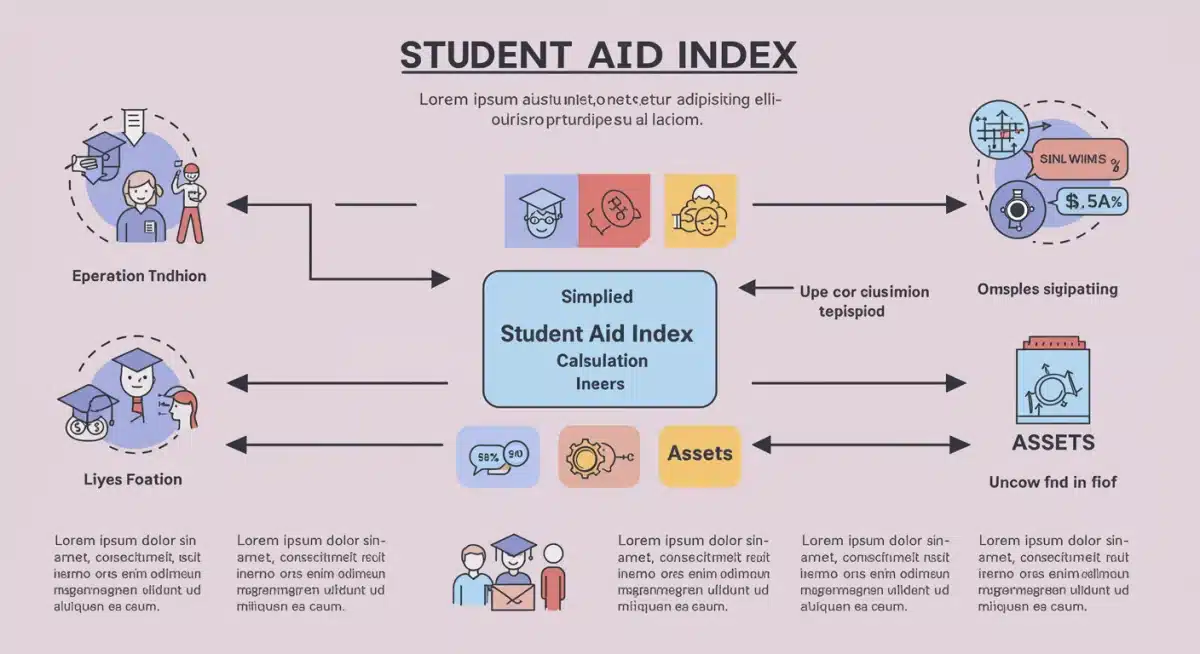
One of the most significant transformations introduced by the FAFSA Simplification Act for the 2025-2026 cycle is the replacement of the Expected Family Contribution (EFC) with the new Student Aid Index (SAI). This change is more than just a name alteration; it fundamentally redefines how a student’s financial need is assessed, aiming for a more accurate and equitable determination of aid eligibility.
The EFC, a long-standing metric, often led to confusion and did not always precisely capture a family’s capacity to contribute to college costs. The SAI seeks to rectify these issues by introducing a new calculation methodology that is intended to be more transparent and responsive to varying financial situations. A key difference is that the SAI can now be a negative number, indicating a higher level of financial need than previously possible under the EFC system.
How SAI Differs from EFC
The shift from EFC to SAI involves several critical methodological changes that will impact how aid packages are structured for students. These differences are designed to provide a more nuanced understanding of financial need and ensure that aid is directed to those who require it most.
- Negative SAI possible: Unlike EFC, SAI can go below zero, indicating extreme financial need and potentially increasing eligibility for Pell Grants.
- Exclusion of family size from calculation: Previously a factor, family size will now be determined by information transferred directly from IRS data, simplifying this aspect.
- Changes in asset assessment: The treatment of certain assets, particularly for small businesses and farms, is being revised to be more favorable to families.
- Child support treated as an asset: Instead of income, child support received will now be counted as an asset, which could impact SAI calculations.
The underlying principle behind the SAI’s design is to create a more direct and less complicated pathway to understanding financial aid eligibility. By simplifying the inputs and refining the calculation, the hope is that students and families will have a clearer picture of their aid potential much earlier in the application process. This clarity can be instrumental in making informed decisions about college enrollment and financial planning.
Simplified FAFSA Application Process
The FAFSA Simplification Act introduces a significantly streamlined application process, aiming to reduce the time and effort required for students and families to complete the form. This overhaul is a direct response to feedback highlighting the complexity and length of the previous FAFSA, which often acted as a deterrent for many potential applicants.
For the 2025-2026 academic year, applicants can expect a considerably shorter form with fewer questions. The number of questions has been reduced from over 100 to approximately 36, making the application process much quicker and less intimidating. This reduction is largely due to the enhanced data exchange capabilities with the IRS, which allows for direct retrieval of tax information.
Key Changes in the Application Flow
The redesigned FAFSA form focuses on efficiency and user-friendliness, incorporating several new features that simplify data entry and submission. These changes are pivotal to improving the overall applicant experience and ensuring that more students successfully complete the application.
- Direct data exchange with IRS: Mandatory use of the IRS Direct Data Exchange (DDX) for income information, reducing manual entry and potential errors.
- Fewer questions: A substantially shorter application form, simplifying the user experience.
- Expanded eligibility for Pell Grants: The new SAI calculation and changes to federal poverty levels aim to broaden Pell Grant eligibility.
- Contributor concept introduced: All individuals providing financial information on the FAFSA are now referred to as ‘contributors,’ which can include parents, stepparents, or the student’s spouse.
The move towards a more integrated and automated data retrieval system is a cornerstone of the simplification effort. By minimizing the need for applicants to manually input sensitive financial data, the new FAFSA aims to decrease errors, improve accuracy, and make the entire process feel less burdensome. This focus on simplification is expected to lead to a higher rate of completed applications and, consequently, more students receiving the financial aid they are entitled to.
Impact on Pell Grant Eligibility
One of the most impactful changes brought about by the FAFSA Simplification Act for the 2025-2026 academic year is the expanded eligibility for Pell Grants. This federal grant program, designed to provide financial assistance to undergraduate students with exceptional financial need, is now accessible to a broader range of students, significantly enhancing their ability to afford higher education.
The new Student Aid Index (SAI) calculation plays a crucial role in this expansion. By allowing the SAI to be a negative number and by adjusting the criteria for determining financial need, more students will qualify for the maximum Pell Grant amount. This change is particularly beneficial for students from low-income backgrounds, who often face the greatest financial hurdles in pursuing a college degree.
How Pell Grant Eligibility is Broadened
The Act introduces specific provisions that directly expand Pell Grant eligibility, ensuring that these vital funds reach a wider student population. These changes are designed to create a more inclusive system that better supports students from diverse economic backgrounds.
- Maximum Pell Grant eligibility tied to federal poverty levels: Students whose family income is at or below 175% (or 225% for single-parent households) of the federal poverty level will automatically qualify for the maximum Pell Grant.
- Minimum Pell Grant eligibility: Students with an SAI below a certain threshold will be eligible for a minimum Pell Grant, even if they don’t qualify for the maximum.
- Streamlined determination: The simplified FAFSA and direct data exchange aid in accurately and efficiently identifying eligible students.
The expansion of Pell Grant eligibility is a cornerstone of the FAFSA Simplification Act’s commitment to equity in education. By broadening access to this fundamental form of financial aid, the Act aims to reduce the financial burden on students and families, making college a more attainable goal. This will undoubtedly have a profound positive effect on college enrollment rates and student success, particularly for those who historically have been underserved by the financial aid system.
Changes for Special Circumstances and Contributors
The FAFSA Simplification Act also introduces significant modifications concerning special circumstances and the definition of a ‘contributor,’ aiming to provide greater flexibility and clarity for students facing unique financial situations. These adjustments are designed to ensure that the financial aid system remains responsive to individual needs, rather than adhering to rigid, one-size-fits-all rules.
Previously, navigating special circumstances, such as job loss, medical expenses, or other unexpected financial hardships, often involved a complex appeal process. The new Act seeks to streamline this by providing clearer guidelines for financial aid administrators to exercise professional judgment. Furthermore, the introduction of the ‘contributor’ concept clarifies who needs to provide financial information, making the application process more straightforward for students from various family structures.
Definition of a Contributor and Special Circumstances
Understanding who is considered a contributor and how special circumstances are handled is essential for accurate FAFSA completion and maximizing aid eligibility. These definitions have been refined to better reflect modern family dynamics and financial realities.
- Definition of ‘contributor’: Any individual required to provide financial information on the FAFSA, which can include parents, stepparents, or a student’s spouse.
- Professional judgment: Financial aid administrators have more explicit authority and guidance to adjust a student’s SAI based on documented special circumstances.
- Expanded dependency overrides: The process for students experiencing homelessness or other difficult family situations to apply as independent students is being simplified.
These changes reflect a move towards a more compassionate and adaptable financial aid system. By providing clearer definitions and empowering financial aid offices with greater discretion, the FAFSA Simplification Act ensures that students facing challenging personal or financial situations are not unduly penalized. This flexibility is vital in ensuring that financial aid can truly serve as a safety net, supporting students through life’s unexpected turns and helping them to continue their educational journeys without unnecessary hurdles.
Important Dates and Next Steps for Applicants
Navigating the new FAFSA Simplification Act for the 2025-2026 academic year requires students and families to be aware of important dates and proactive steps. While the application process is designed to be simpler, timely submission and understanding the new requirements remain critical for maximizing financial aid opportunities.
The FAFSA for the 2025-2026 academic year is typically available in the fall of the preceding year. It is crucial to monitor official announcements from Federal Student Aid (FSA) and your chosen educational institutions for the exact opening date. Early application is always recommended, as some aid is distributed on a first-come, first-served basis, and meeting institutional deadlines is paramount.
Key Actions for Prospective Students
To ensure a smooth application process and secure optimal financial aid, students should take several proactive steps. These actions will help them prepare for the new FAFSA and effectively manage their financial aid journey.
- Create an FSA ID: Both student and at least one parent (if dependent) will need an FSA ID to access and sign the FAFSA. This should be done well in advance.
- Gather necessary documents: Although simplified, applicants will still need tax information (via IRS DDX), records of untaxed income, and asset information.
- Understand the new SAI: Familiarize yourself with how the Student Aid Index is calculated and how it might impact your eligibility.
- Check college-specific deadlines: Many institutions have their own priority deadlines for financial aid, which are often earlier than the federal deadline.
- Seek assistance: Don’t hesitate to reach out to your high school counselor or college financial aid office for help with any questions.
Being well-informed and organized will significantly ease the transition into the new FAFSA system. Proactive preparation, coupled with an understanding of the changes, empowers students to navigate the financial aid landscape effectively, ensuring they can access the resources needed to pursue their educational aspirations. The goal of the FAFSA Simplification Act is to make this process easier, but student engagement remains a key factor in success.
| Key Change | Brief Description |
|---|---|
| EFC to SAI | Expected Family Contribution (EFC) is replaced by Student Aid Index (SAI), which can be negative. |
| Simplified Application | Fewer questions (around 36) and mandatory IRS Direct Data Exchange for income. |
| Pell Grant Expansion | Broader eligibility for Pell Grants, with automatic maximum grants for certain income levels. |
| Contributor Definition | Clarifies who provides financial information, including parents, stepparents, or spouse. |
Frequently Asked Questions About FAFSA Simplification
The primary goal of the FAFSA Simplification Act is to streamline the federal student aid application process, make it easier for students to apply, and expand eligibility for federal financial aid, particularly Pell Grants, for the 2025-2026 academic year and beyond.
The SAI replaces the EFC and uses a new calculation methodology. Unlike the EFC, the SAI can be a negative number, indicating greater financial need. It also simplifies how family size and certain assets are considered, aiming for a more accurate assessment of a family’s ability to pay.
Yes, significantly. The FAFSA Simplification Act reduces the number of questions on the application from over 100 to approximately 36. This change, coupled with mandatory direct data exchange with the IRS, aims to make the application process much quicker and less complex for applicants.
The Act expands Pell Grant eligibility. More students will qualify for maximum Pell Grants based on federal poverty levels, and a minimum Pell Grant will be available to students whose SAI falls below a certain threshold, even if they don’t meet the maximum grant criteria.
A ‘contributor’ is any individual required to provide financial information on the FAFSA. This typically includes the student, their parents (biological or adoptive), stepparents if applicable, or a student’s spouse. All contributors must consent to share their tax information via the IRS Direct Data Exchange.
Conclusion
The FAFSA Simplification Act marks a pivotal moment in federal student financial aid, introducing comprehensive changes designed to make higher education more accessible and affordable for students across the United States. From replacing the EFC with the more nuanced Student Aid Index to streamlining the application process and expanding Pell Grant eligibility, these reforms aim to create a fairer, clearer, and more efficient system. While the transition may require some adjustment for students and families, the ultimate goal is to empower more individuals to pursue their educational dreams without undue financial burden. Staying informed about these changes and proactively preparing for the application process will be key to unlocking the full potential of these new financial aid opportunities.