A Comparative Look at Online vs. In-Person Learning Outcomes for US Students in 2026
The educational landscape has undergone a seismic shift in recent years, propelled by technological advancements and unforeseen global events. As we look towards 2026, the debate surrounding online vs in-person learning outcomes for US students remains more relevant than ever. This comprehensive analysis delves into the multifaceted aspects of both modalities, examining their impact on academic performance, socio-emotional development, and skill acquisition. Understanding these distinctions is crucial for educators, policymakers, parents, and students alike, as we navigate an increasingly diverse and dynamic educational future.
The Evolving Landscape of Education: A Pre-2026 Perspective
Before dissecting the specific learning outcomes, it’s essential to acknowledge the journey that has brought us to this juncture. The early 2020s accelerated the adoption of online learning tools and methodologies out of necessity. This period served as a grand experiment, revealing both the immense potential and inherent challenges of remote instruction. While many initially viewed online learning as a temporary measure, its integration into the fabric of education has proven to be far more enduring. By 2026, educational institutions across the US are expected to have refined their approaches to both online and in-person instruction, often blending the two into hybrid models. This evolution necessitates a rigorous examination of which mode best serves the diverse needs of students.
The core of this discussion revolves around defining what constitutes ‘successful learning outcomes.’ Is it solely academic achievement, measured by grades and test scores? Or does it encompass a broader spectrum, including critical thinking, problem-solving, creativity, collaboration, and socio-emotional well-being? Our exploration of online vs in-person learning outcomes will consider this holistic view, recognizing that education is about more than just transmitting information.
Academic Performance: A Head-to-Head Comparison
Measuring Success: Grades, Test Scores, and Retention
When comparing online vs in-person learning outcomes, academic performance is often the most straightforward metric. Studies from the past decade have presented mixed results, often depending on the subject matter, student demographics, and the quality of instructional design. In traditional in-person settings, direct interaction with instructors and peers can facilitate immediate clarification of concepts, fostering a deeper understanding. The structured environment of a physical classroom can also minimize distractions, potentially leading to better focus and retention for some students.
Conversely, well-designed online courses, especially those leveraging adaptive learning technologies and personalized feedback, have shown comparable or even superior academic results in certain contexts. Students who thrive in online environments often possess strong self-discipline, time management skills, and a high degree of intrinsic motivation. The flexibility of online learning can allow students to learn at their own pace, revisit complex topics, and engage with materials in ways that suit their individual learning styles. For subjects requiring extensive hands-on laboratory work or direct practical application, in-person learning often maintains an edge, though virtual labs and augmented reality simulations are rapidly closing this gap.
By 2026, we anticipate that the quality of online instructional design will have significantly improved, with educators becoming more adept at creating engaging and effective virtual learning experiences. This refinement will likely narrow the academic performance gap between online vs in-person learning outcomes, making the choice between the two less about academic rigor and more about individual student needs and preferences.
The Role of Technology in Academic Achievement
Technology is not merely a delivery mechanism for online learning; it’s an integral component that can enhance both online and in-person experiences. In 2026, advanced AI-powered learning platforms are expected to provide highly personalized educational pathways, identifying student strengths and weaknesses and offering targeted interventions. This level of customization, while potentially available in both settings, often finds its most robust application in online environments where data collection and analysis are more seamless.
For in-person learning, technology will continue to transform classrooms into interactive hubs, with smart boards, virtual reality tools, and collaborative digital platforms enriching traditional instruction. The key distinction in academic outcomes will likely hinge on how effectively these technologies are integrated and utilized by educators in each setting, rather than the technology itself being exclusive to one mode over the other. The challenge will be to ensure equitable access to these technological resources for all students, regardless of their chosen learning path.
Socio-Emotional Development: A Critical Lens
Building Social Skills and Community in Different Settings
Beyond academic metrics, socio-emotional development is a cornerstone of a well-rounded education. In-person learning environments traditionally excel at fostering social skills, teamwork, and a sense of community. Daily interactions with peers and teachers provide invaluable opportunities for developing communication, empathy, conflict resolution, and leadership abilities. The informal learning that occurs during breaks, extracurricular activities, and group projects plays a significant role in shaping a student’s social intelligence and emotional resilience.
The challenge for online learning has historically been replicating this rich social tapestry. While virtual platforms offer discussion forums, group video calls, and collaborative online tools, they often fall short of the spontaneous and nuanced interactions found in physical spaces. By 2026, however, advancements in virtual reality (VR) and augmented reality (AR) are expected to create more immersive and interactive online social experiences. Virtual common rooms, digital project spaces, and even metaverse-like educational environments could help bridge the gap in social interaction for online learners.
Despite these technological advancements, the direct human connection facilitated by in-person learning remains a powerful force for socio-emotional growth. The ability to read non-verbal cues, engage in impromptu conversations, and participate in shared physical experiences contributes uniquely to a student’s development. Therefore, when evaluating online vs in-person learning outcomes, the socio-emotional dimension often leans towards the benefits of physical interaction, especially for younger students.
Mental Health and Well-being Considerations
The mental health and well-being of students are paramount. The isolation sometimes associated with online learning can contribute to feelings of loneliness, anxiety, and depression for some individuals. The blurring of lines between home and school, coupled with increased screen time, can also impact mental health. In-person schools, on the other hand, often provide built-in support systems, including school counselors, peer networks, and opportunities for physical activity and stress reduction.
However, it’s also important to acknowledge that in-person settings can present their own stressors, such as social pressures, bullying, and the demands of a rigid schedule. For some students, particularly those with social anxieties or specific learning needs, the online environment can offer a safer and less overwhelming space to learn and thrive. By 2026, both online and in-person educational models will need to prioritize robust mental health support, integrating counseling services, mindfulness practices, and resources for digital well-being into their core offerings. The comparative online vs in-person learning outcomes in this area will largely depend on the proactive measures taken by institutions to support student mental health in each specific context.
Skill Acquisition: Beyond Rote Memorization
Developing 21st-Century Skills
The modern workforce demands more than just factual knowledge; it requires critical thinking, problem-solving, creativity, communication, and collaboration – often referred to as 21st-century skills. Both online and in-person learning environments have the potential to cultivate these skills, but they often do so through different pathways.
In-person learning, with its emphasis on group projects, debates, and hands-on activities, naturally fosters collaborative and communication skills. The immediate feedback from peers and instructors during these activities is invaluable. Critical thinking and problem-solving are encouraged through classroom discussions and direct application of concepts in a supervised setting.
Online learning, particularly when designed effectively, can be a powerful incubator for self-directed learning, digital literacy, and independent problem-solving. Students in online environments often develop strong research skills, learn to navigate digital tools proficiently, and become adept at managing their own learning process. Collaborative online projects can teach students how to work effectively in virtual teams, a skill increasingly vital in a globalized workforce. Creative thinking can be sparked through multimedia project creation and innovative digital presentations.
The key to successful skill acquisition in both settings by 2026 lies in pedagogical approaches that move beyond traditional lecturing. Project-based learning, inquiry-based learning, and experiential learning models will be crucial, whether delivered in a physical classroom or a virtual one. The comparative online vs in-person learning outcomes in 21st-century skills will depend on the intentional design of curricula and the training of educators to implement these modern teaching strategies effectively.
The Impact on Digital Literacy and Adaptability
One undeniable advantage of online learning is its inherent ability to enhance digital literacy. Students engaged in online courses are constantly interacting with digital platforms, learning management systems, communication tools, and online resources. This continuous exposure builds proficiency in navigating the digital world, a fundamental skill for any future career path. This is a significant factor when considering online vs in-person learning outcomes in terms of future readiness.
While in-person learning increasingly incorporates digital tools, the foundational reliance on digital platforms is more pronounced in online education. This can lead to a higher degree of adaptability among online learners, preparing them for a world where remote work and digital collaboration are commonplace. However, it’s important to ensure that this digital proficiency is balanced with critical thinking about online information and responsible digital citizenship, which can be taught and reinforced in both settings.
Factors Influencing Outcomes: Beyond the Modality Itself
It’s an oversimplification to declare one mode inherently superior to the other. The true determinants of online vs in-person learning outcomes are often influenced by a complex interplay of factors:
- Student Characteristics: Individual learning styles, self-regulation skills, motivation levels, and prior academic performance play a significant role. Some students naturally thrive in independent online settings, while others require the structure and immediate support of a physical classroom.
- Instructor Effectiveness: A skilled and engaging teacher can make any learning environment effective. In online settings, this means proficiency in using digital tools, fostering virtual community, and providing timely feedback. In-person, it involves dynamic classroom management and interactive instruction.
- Instructional Design: The quality of the curriculum and how it’s presented is paramount. Well-designed online courses with clear objectives, engaging activities, and robust assessments will outperform poorly structured in-person classes, and vice-versa.
- Access to Resources: This includes reliable internet access, appropriate devices, a conducive learning environment at home (for online learners), and access to physical resources like libraries and labs (for in-person learners). Equity in access remains a critical challenge for both modalities.
- Parental/Guardian Support: Especially for K-12 students, the level of support at home can significantly impact learning outcomes in both online and in-person environments.
By 2026, educational institutions will be more adept at identifying which students are best suited for each learning modality and providing the necessary support to optimize their success. The goal is not to force all students into one mold but to offer tailored educational experiences that maximize their potential.
The Rise of Hybrid and Blended Learning Models
As the conversation around online vs in-person learning outcomes matures, the focus is increasingly shifting towards hybrid and blended learning models. These approaches seek to combine the best elements of both worlds: the flexibility and personalized pace of online learning with the social interaction and direct support of in-person instruction.
In a hybrid model, students might attend some classes physically and complete others online, or alternate between the two on a rotating schedule. Blended learning often involves integrating online activities and resources within a predominantly in-person classroom setting. By 2026, these models are expected to become the norm for many educational institutions, offering a flexible and adaptable framework that can cater to a wider range of student needs and preferences.
The success of hybrid models will depend on seamless integration of technologies, effective communication between online and in-person components, and educators trained to facilitate learning across both domains. The aim is to achieve superior learning outcomes by leveraging the strengths of each modality while mitigating their weaknesses.
Conclusion: Navigating the Future of Education in 2026
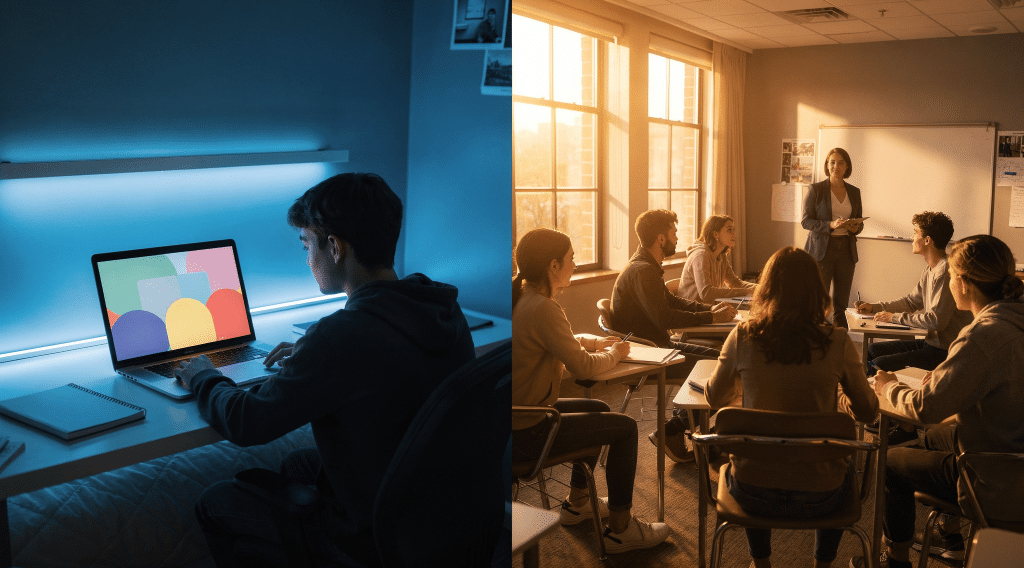
The debate over online vs in-person learning outcomes for US students in 2026 is not about declaring a single winner, but rather about understanding the nuanced strengths and challenges of each approach. Both modalities offer unique advantages and disadvantages that impact academic performance, socio-emotional development, and the acquisition of 21st-century skills.
In-person learning continues to offer unparalleled opportunities for social interaction, community building, and immediate feedback, which are crucial for many aspects of development. Online learning, meanwhile, provides flexibility, fosters self-discipline, enhances digital literacy, and can offer personalized learning pathways previously unimaginable.As we move further into the decade, the most effective educational strategies will likely involve a thoughtful integration of both. Institutions that can skillfully blend online and in-person elements, provide robust support for student well-being, and empower educators with the necessary tools and training will be best positioned to optimize learning outcomes for all US students. The future of education is not about choosing one over the other, but about intelligently combining them to create rich, equitable, and effective learning experiences that prepare students for a rapidly changing world.